Kent Monkman: The Parallel Journeys in Miss Chief’s Wet Dream
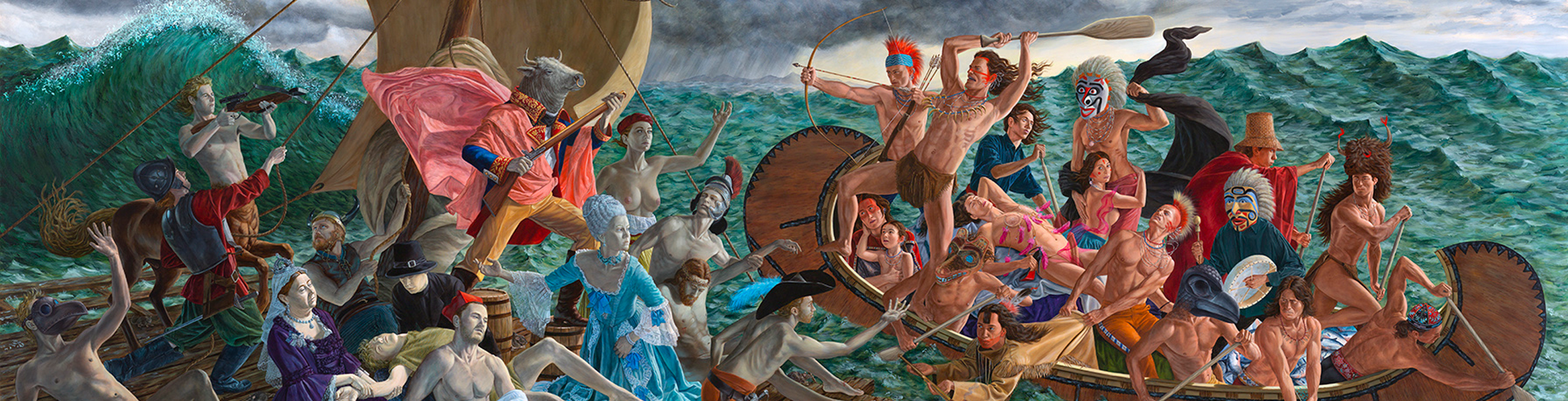
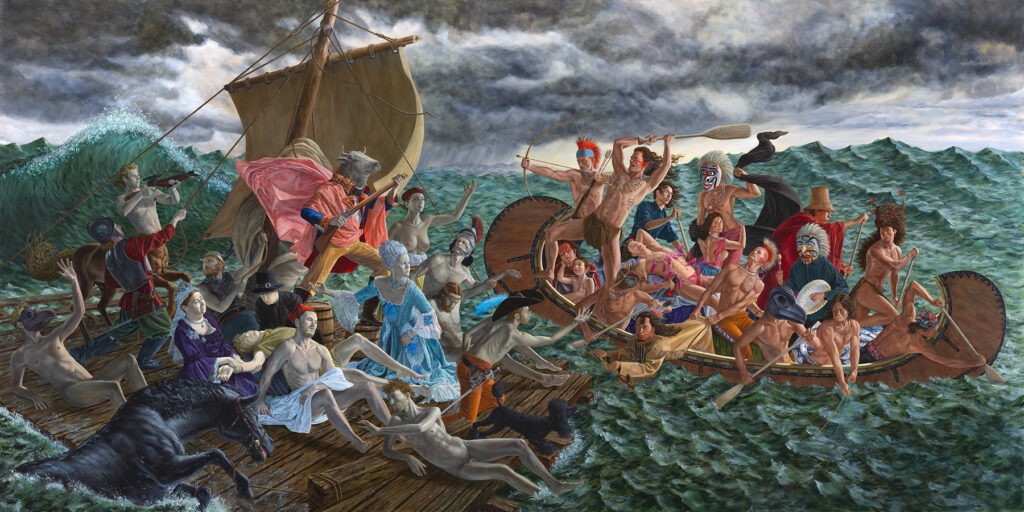
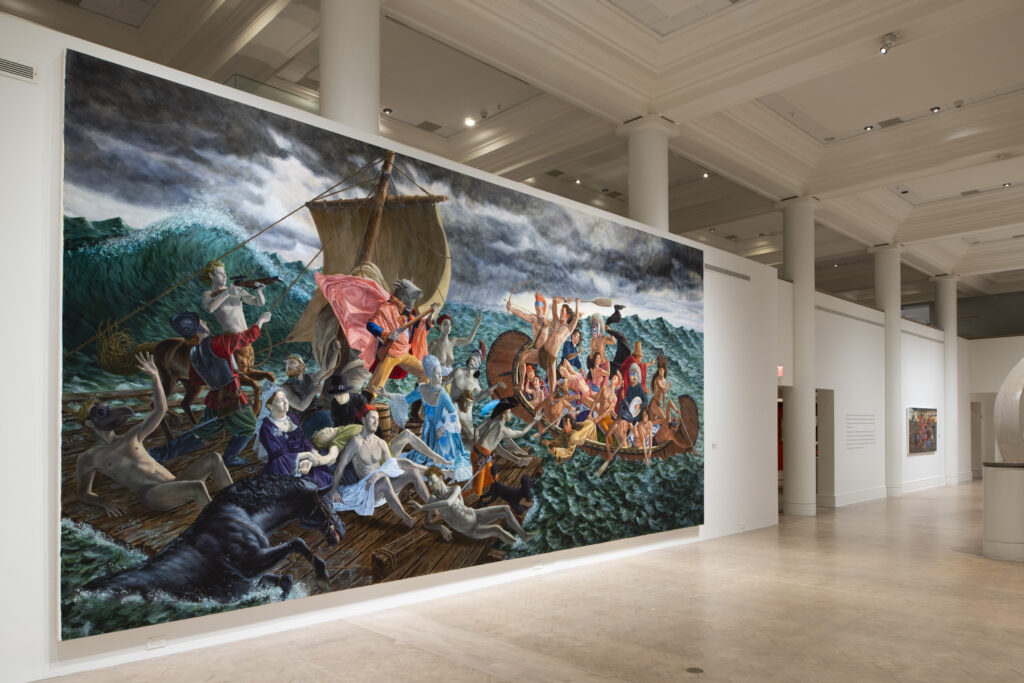
A turbulent sea stretches across Kent Monkman’s Miss Chief’s Wet Dream (2018), where two vessels navigate uncertain waters: one a precarious European raft, the other a robust Indigenous canoe.
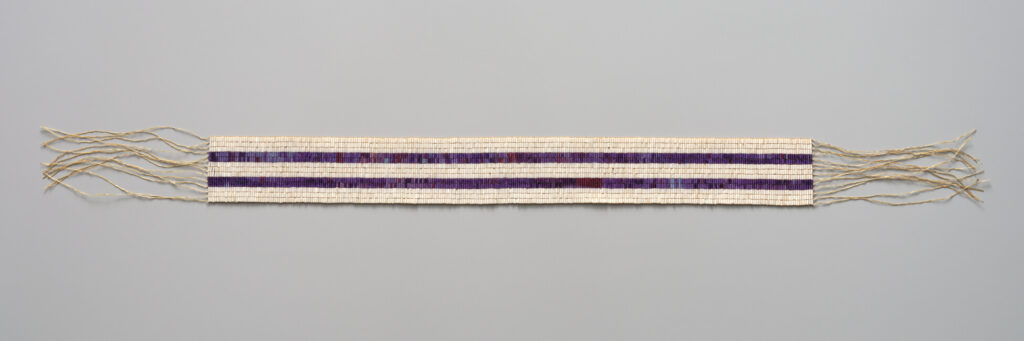
Monkman’s composition draws inspiration from the 1613 Teioháte Kaswenta (Two Row Wampum Belt Treaty), an agreement between the Haudenosaunee Confederacy and representatives of the Dutch government. Teioháte Kaswenta established a relationship in which two nations would travel alongside one another, each following their own path while respecting the autonomy of one another. In Miss Chief’s Wet Dream (2018), Monkman reinterprets this idea through two vessels whose paths converge rather than remain parallel. Their proximity creates a visual tension through which this painting considers the challenges and consequences of broken agreements.
The raft incorporates visual references to Jean Louis Théodore Géricault’s The Raft of the Medusa (1818-1819). It is crowded with figures drawn from European mythology and history, including characters wearing military sashes and uniforms reminiscent of Jacques-Louis David’s portraits of Napoleon in the series Napoleon Crossing the Alps (1800-1801). Other figures appear in poses that recall the movement and theatricality of Eugène Delacroix’s paintings. The raft is sharply angled, while its passengers reach, recoil, and interact with one another, contributing to the sense of instability within the scene.
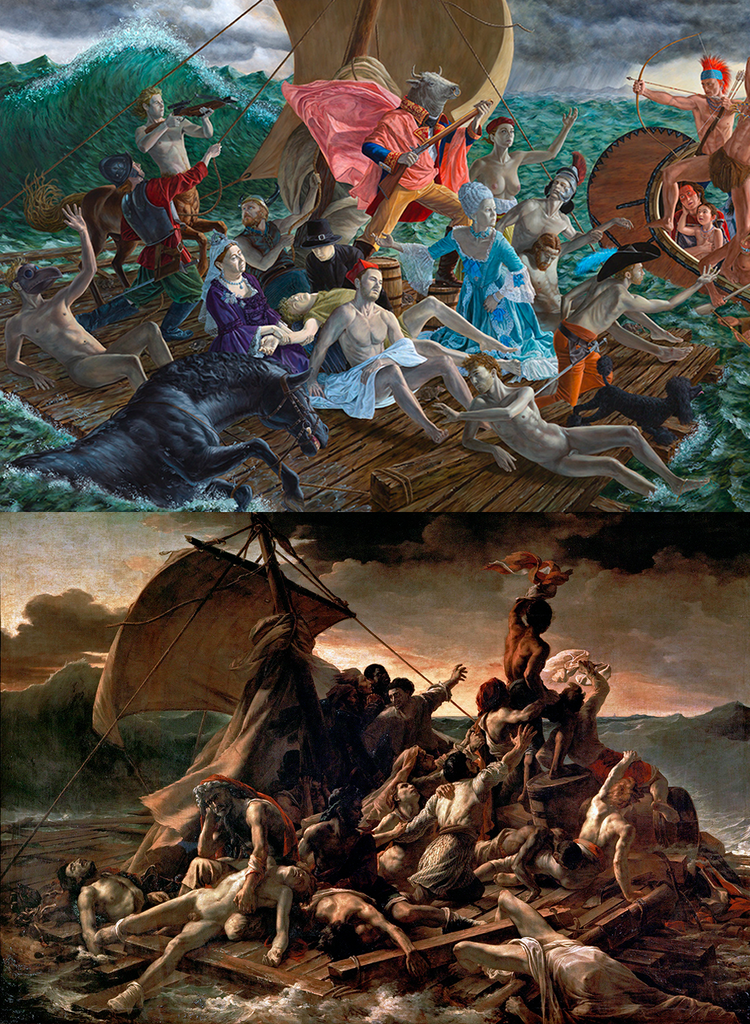
Jean Louis Théodore Géricault, The Raft of the Medusa, 1818-1819 (bottom). Oil on canvas. 491.0 × 716.0 cm. The Louvre Museum, Paris, France.
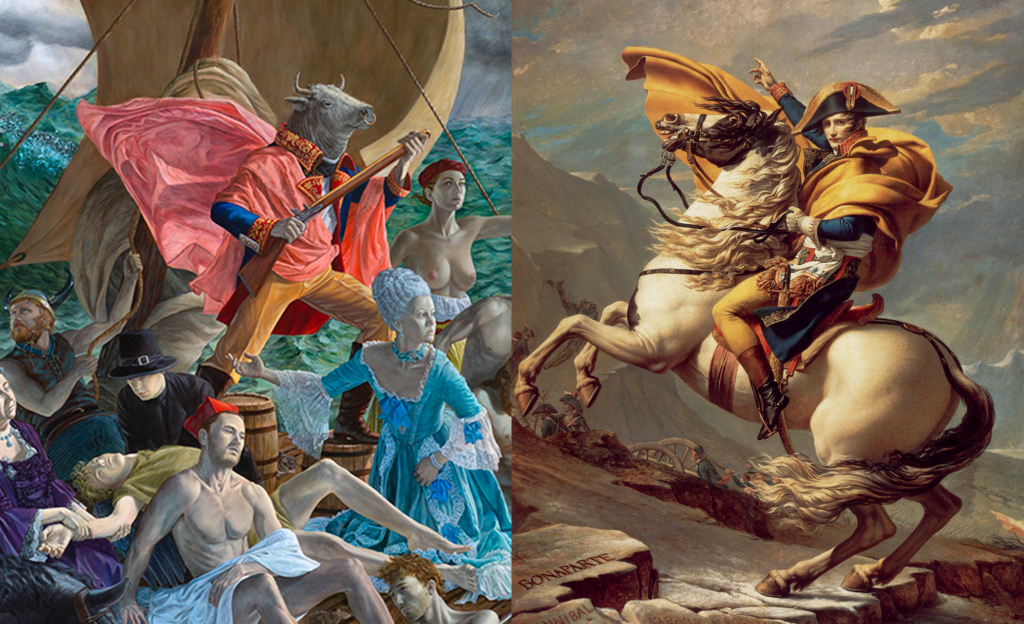
Jacques-Louis David, Napoleon Crossing the Alps, 1800-1801 (right). Oil on canvas. 259.0 × 221.0 cm. Château de Malmaison.
In contrast, the canoe moves through the composition on a different trajectory. Monkman draws on large traditional canoes made of tree bark, Haudenosaunee longboats, as well as the monumental canoe depicted in Bill Reid’s The Spirit of Haida Gwaii, the Black Canoe (1986). The canoe features representations of Indigenous peoples from various sources: people in regalia and traditional masks from museum collections—such as the Tsimshian wolf mask— dancers, leaders, knowledge keepers, and storytellers. The canoe also features depictions of Indigenous Peoples by non-Indigenous painters including figures from the pacific Northwest Coast wearing ceremonial regalia inspired by Paul Kane’s Medicine Mask Dance (1849-1856), George Catlin’s Buffalo Dance (1844) featuring Mandan ceremonial regalia, and other details including intergenerational dynamics and abundance. Traditional beadwork and textiles drawn from museum collections further connect the scene to Indigenous artistic traditions and material culture.
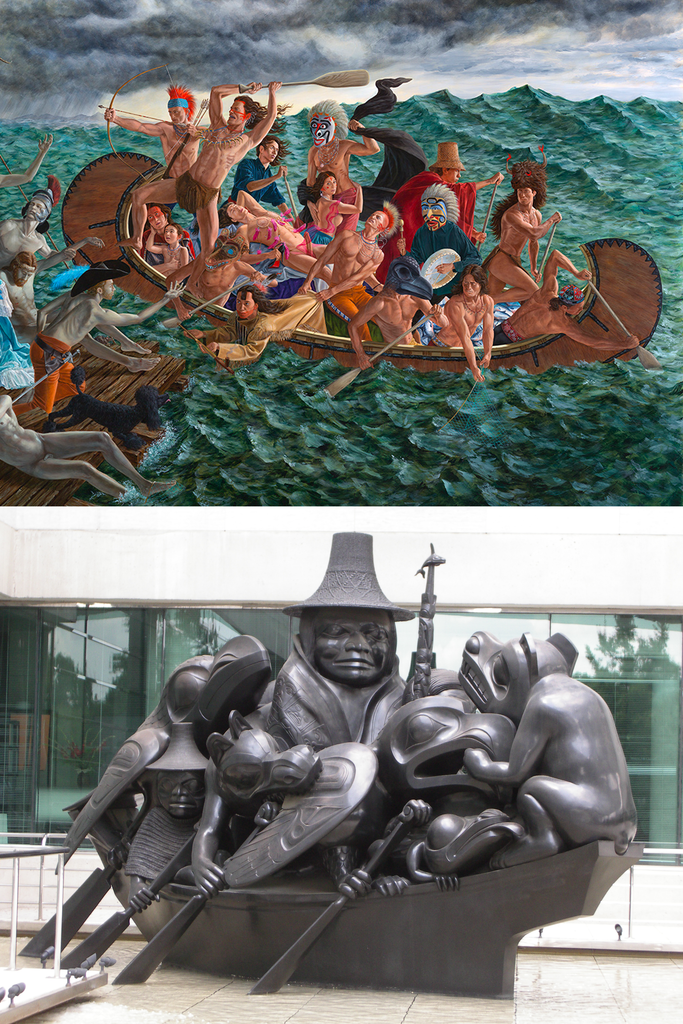
Bill Reid, The Spirit of Haida Gwaii, the Black Canoe, 1986. Bronze and plaster. 389.0 × 348.0 × 605.0 cm. Canadian Embassy, Washington, D.C., USA.
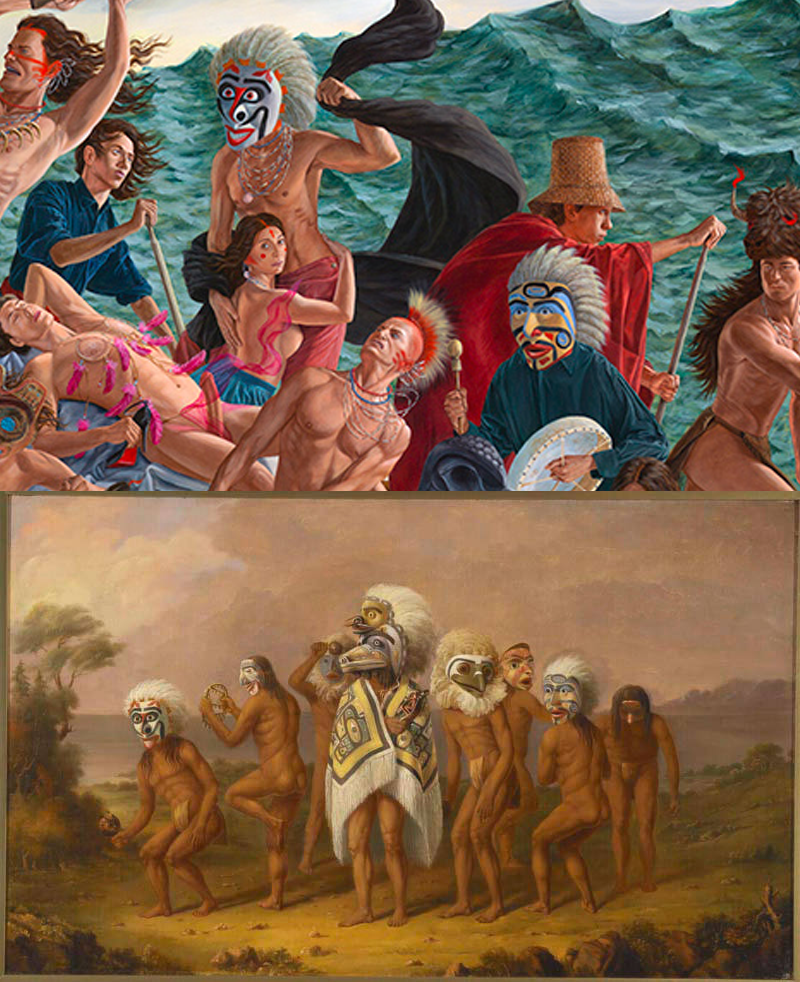
Paul Kane, Medicine Mask Dance, 1849-1856. Oil on canvas. 45.3 × 73.8 cm. Royal Ontario Museum, Toronto, Ontario.
The interaction between the two vessels is charged with meaning. Figures on the raft look toward the canoe, with some reaching outward while others turn away. The passengers in the canoe respond through gestures and expressions that suggest different forms of observation, resistance, and negotiation. Rather than depicting a harmonious encounter, Monkman presents a moment of uncertainty that can be read in relation to the history and ongoing negotiation of treaty relationships.
Water and weather also play an important role in Miss Chief’s Wet Dream (2018). Monkman uses broad, swirling brushstrokes to give the ocean a sense of movement, while dark clouds and crashing waves surround the vessels. The contrasting conditions around the raft and canoe contribute to the painting’s visual tension. As Monkman has said, “This idea of turbulence, of dreaming, of these European cultures and Indigenous cultures colliding; those are some of the overarching themes explored within the work.”
The painting incorporates references to historical garments, accessories, European art history, and Indigenous storytelling. Géricault’s survivors, David’s imagery associated with imperial power, and Delacroix’s Romantic compositions appear alongside Indigenous figures and Northwest Coast artistic motifs. Miss Chief’s Wet Dream (2018) does not resolve the tensions between the two vessels. Instead, the storm, angled boats, and interactions between the figures create a scene in which different possibilities remain open. These elements questions which histories are privileged and provides a framework for navigating the ongoing complexities of coexistence and reconciliation.